
Laser Overlap Welding of 0.3mm SUS304 Terminals: Split-and-Weld Case
Industry SolutionsBeipin Laser case: two 0.30mm SUS304 1/2H stainless steel halves overlap-welded into one terminal on the strip, using galvo laser welding with a hold-down plate and locating-pin fixture. Requirements: pull force 100 N or more, flatness within 0.05mm, local warpage within 0.03mm, dimensions within 0.02mm. Free sample testing....
Solution Details:
Summary: A 2025 project for a precision terminal maker. Two 0.30 mm SUS304 1/2H (half-hard) stainless steel halves are overlap-welded on the strip into one terminal assembly, using galvo-scanner laser welding with a hold-down plate and locating-pin fixture. Project requirements: pull force ≥100 N per weld point or segment (base metal must fail first), overall flatness ≤0.05 mm, local warpage ≤0.03 mm, and dimensions still within ±0.02 mm and ±1° after welding.
Part and welding requirements
| Material | SUS304 stainless steel, 1/2H half-hard |
|---|---|
| Thickness / strip width | 0.30±0.01 mm / 46.0±0.1 mm |
| Joint | Overlap weld: left and right halves welded into one terminal assembly |
| Pull test | ≥100 N per weld point or segment; base metal fracture preferred, no separation or tearing at the weld; pull speed 10 mm/min, perpendicular to the weld |
| Appearance | Continuous, even weld with no obvious breaks, pores, blow-outs or heavy spatter; no heavy blackening, burning or burn-through pits; no spatter, oil, dust or slag on visible faces; burrs around the weld still ≤0.02 mm; very slight melt marks allowed if they do not stand above the mating surface |
| Distortion | Overall flatness ≤0.05 mm (checked with a gauge); warpage around the weld ≤0.03 mm; dimensions ±0.02 mm and angles ±1° after welding |
| Strip | Coil direction specified by the customer; strip camber ≤25 mm/1000 mm |
These are the project's technical requirements. Acceptance follows the drawings, gauges and test methods agreed by both sides.
Why stamp two halves and weld them
- The part does not fit one strip layout: the complete terminal is wider than a single strip can produce in one progressive die, so it is cut as two halves and welded into one assembly.
- Existing coil and feed direction: the customer specified coil direction and camber limits; cutting left and right halves uses the existing coil width and avoids buying wide material and large wide dies.
- Strength and datums for assembly: once welded, the two halves act as one rigid part, so they do not shift or separate in later assembly, and the key dimensions and angles stay stable.
- Easier forming: half-hard SUS304 springs back strongly; forming two smaller halves reduces bending difficulty and accumulated springback.
The solution: galvo laser welding plus a hold-down fixture
- Galvo-scanner welding: fast scanning and concentrated energy keep the heat-affected zone small, which makes distortion on 0.3 mm sheet easier to control; galvo positioning keeps the weld location stable.
- Hold-down plate and locating pins: the strip is located by pins and clamped flat by a cover plate during the whole weld to suppress thermal warpage, so key dimensions stay consistent.
- No consumables: no filler wire, solder paste or flux, and no cleaning after welding.
- Lower tooling cost: two small cutting dies cost less and take less time than one large progressive die, and are easier to modify.
Part, fixture and machine
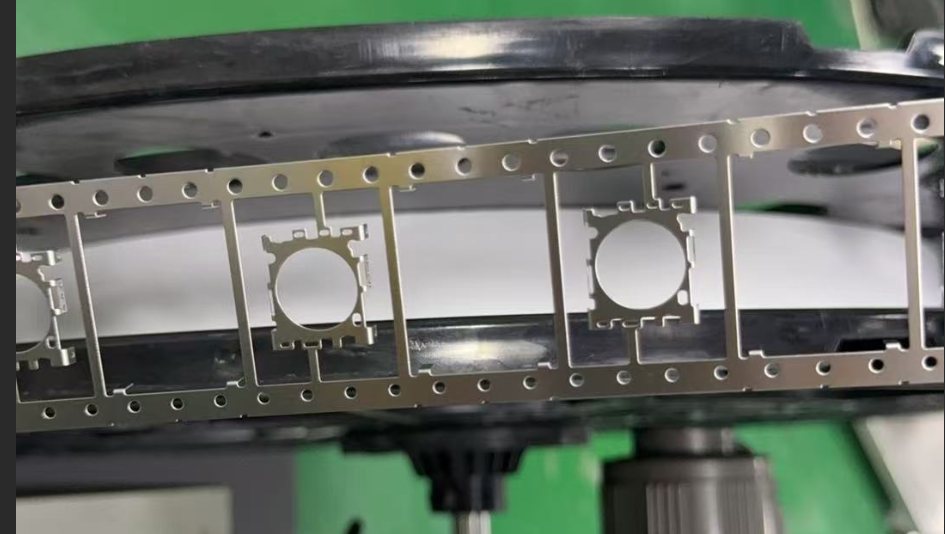
SUS304 terminal strip, 0.30 mm thick.
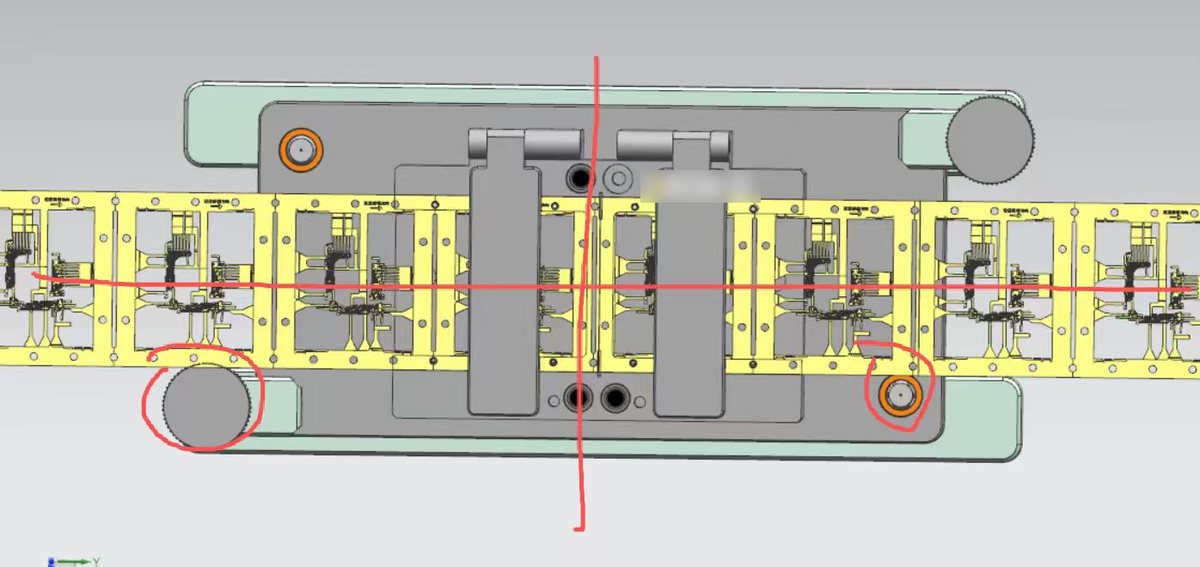
Fixture design: locating pins and hold-down plate; red lines mark the datums.
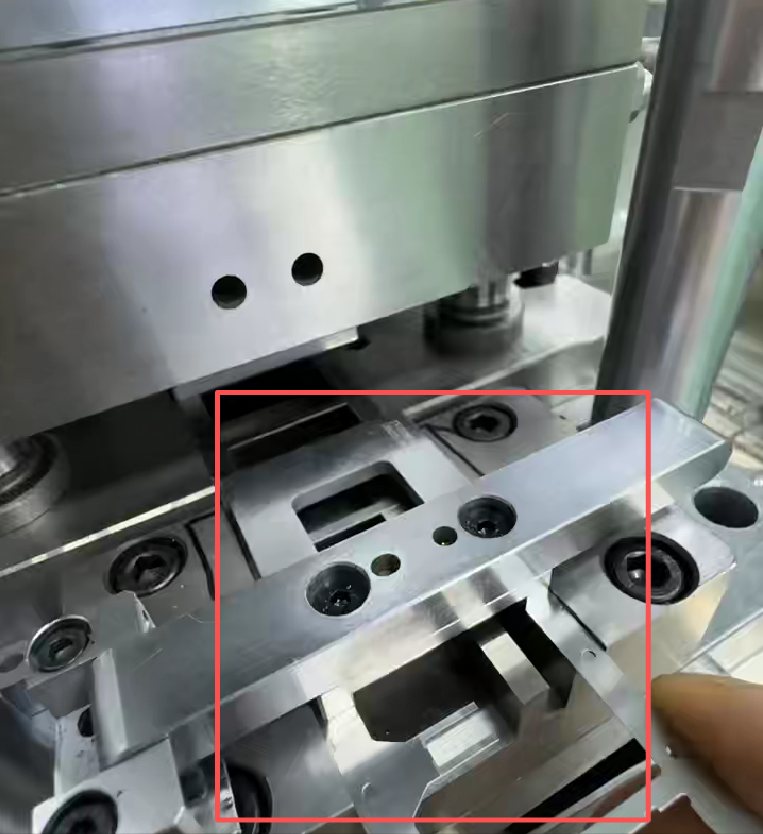
Fixture loading area; the red box marks the hold-down plate.
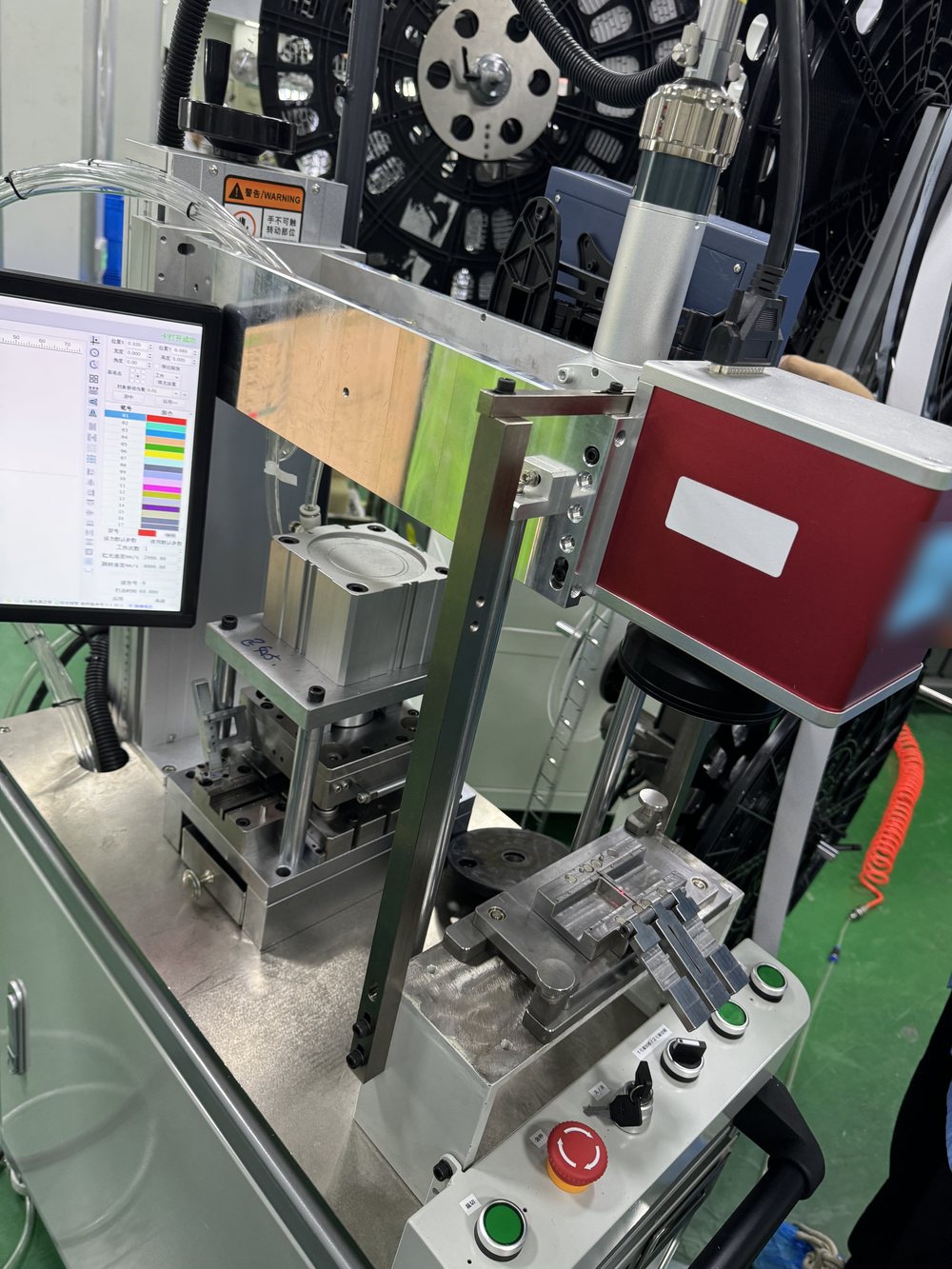
Welding station: galvo welding head, pneumatic clamping and strip fixture.
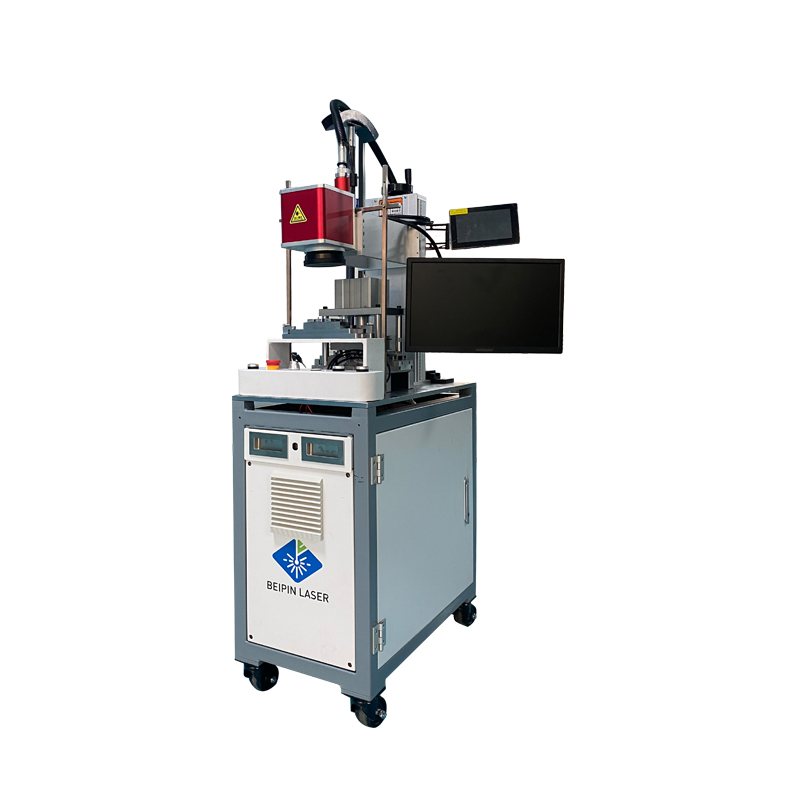
The galvo laser welding machine used in this project.
Similar parts
Thin stainless steel or copper-alloy strip terminals, connector terminals, shields and spring contacts that must be welded from two pieces and still meet tight flatness, dimension and pull-force requirements. Parameters and fixtures depend on material, thickness and joint, so we confirm them on your samples.
FAQ
How do you control distortion when overlap welding 0.3 mm stainless steel?
Three things: galvo welding with concentrated heat and a small heat-affected zone; clamping the part flat with a cover plate and locating pins during welding; and checking flatness and local warpage with a gauge afterwards. This project required overall flatness ≤0.05 mm and local warpage ≤0.03 mm.
How is weld strength checked?
By a pull test at 10 mm/min, perpendicular to the weld: at least 100 N per point or segment, with the base metal failing before the weld. We run pull tests and metallographic cross-sections in-house during sample testing.
Why not stamp the whole part in one progressive die?
The complete part is wider than one strip layout allows. Two halves welded together need smaller, cheaper dies, shorter development time and the existing coil width.
Have a similar terminal, connector or thin-sheet overlap weld? Send samples for a free test: results usually 2–3 days after we receive the parts, with pull-test and cross-section data. Free sample test · Precision Laser Welding Machine · WhatsApp +86 186 1631 3040
Contact Us
We’d love to hear from you, and we promise no spam