
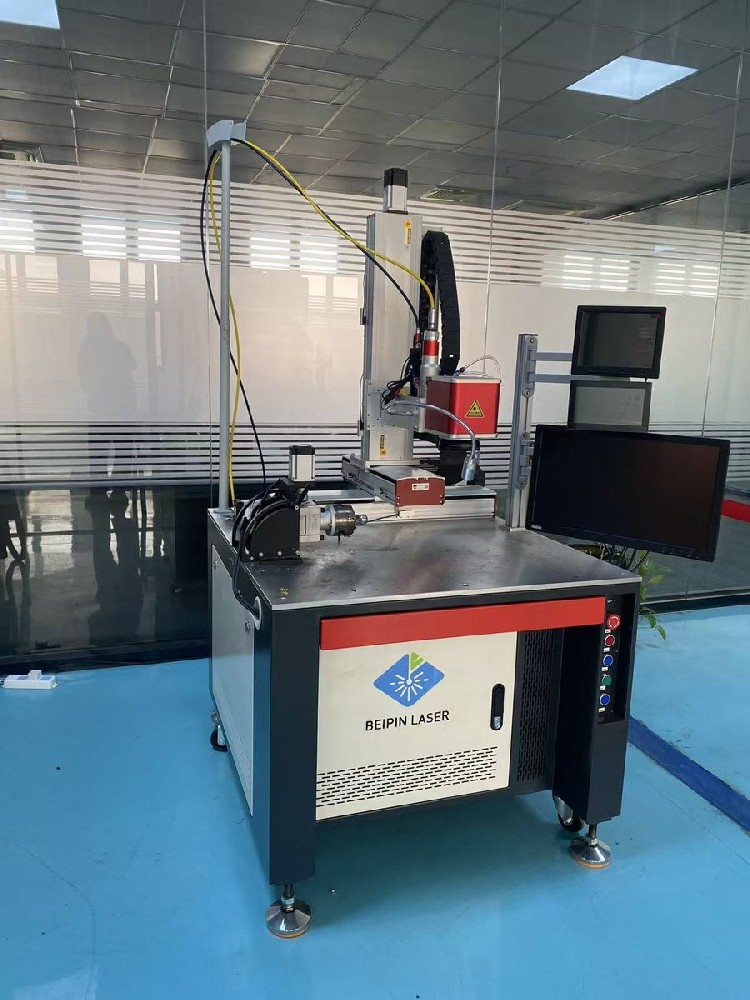
How to Specify a 150W Air-Cooled QCW Laser Spot Welder (RFQ)
Short answer: When writing an RFQ or comparing quotes for a 150W air-cooled QCW laser spot welder, look past headline average power and verify six concrete engineering items: peak power & pulse width range, actual adjustable working spot range, three-stage pulse shaping, clear separation between coaxial CCD observation and motion stage repeatability, whether optical negative-feedback closed-loop monitoring is standard or optional, and what factory acceptance testing is performed in-house versus via third-party labs.
Six specification items every QCW spot welder RFQ should lock down
| RFQ item | Reference benchmark (Beipin BP-W-P150) | Common RFQ ambiguity to avoid |
|---|---|---|
| Laser source & cooling | 150 W average / 1500 W peak, 1070 ± 10 nm precision air-cooled QCW fiber laser | Confirming peak power and pulse duration (0.2–50 ms), not just average wattage |
| Working process spot | 0.10–0.30 mm adjustable process spot (50 / 100 μm fine-core fiber) | Confusing theoretical minimum focus spot with the practical conduction-welding spot range |
| Pulse waveform control | Programmable three-stage pulse shaping (ramp-up, plateau, ramp-down) | Basic single-rectangle pulses that trigger spatter on copper, gold-tin, or thin stainless foil |
| CCD vision vs. stage precision | 2 MP coaxial CCD visual observation + precision motion stage (±0.01 mm repeatability) | Listing ±0.01 mm as "CCD accuracy" or "final weld position tolerance" (machine repeatability ≠ part tolerance) |
| Energy stability & closed-loop | ≤ ±2% system energy stability; independent real-time optical negative-feedback closed-loop module as an option | Assuming real-time optical closed-loop feedback or per-shot interlock alarms are included by default without confirming the optional module |
| Shielding gas & fixturing | Coaxial or side-blow high-purity N2 or Ar; custom part-locating tooling | Ignoring clamping heat-sink consistency and part-to-part gap control, which often matter more than laser wattage |
Why separating CCD observation from stage repeatability matters
Coaxial CCD cameras show the operator or vision software where the laser optical axis lands on the workpiece, eliminating off-axis parallax. However, physical positioning repeatability (±0.01 mm on a standard precision stage) is governed by the mechanical motion axes, while final weld placement accuracy on a finished part also depends on fixture datum repeatability, incoming part dimensional tolerances, and thermal distortion. Separating these terms in your technical agreement prevents acceptance disputes during FAT and SAT.
Factory acceptance & sample validation checklist
Sample size: Supply 15–20 representative production sets (not hand-selected lab pieces) so variation in plating, gap, and flatness is exposed early.
In-house factory inspection: Beipin Laser routinely performs high-magnification optical microscopy visual inspection and push/pull mechanical testing in Kunshan.
External specialized analysis: If your acceptance protocol requires metallographic cross-sectioning, X-ray void inspection, or hermetic helium leak verification, specify whether testing will be coordinated through an external third-party laboratory or your internal QC facility.
Process traceability: Confirm recipe storage, shielding gas flow verification, and any optional monitoring/MES interface requirements before design freeze.
Preparing an RFQ for a 150W QCW spot welding system? Send your drawings and acceptance criteria for a structured technical proposal. BP-W-P150 QCW Spot Welder · Sample Test Request · WhatsApp +86 186 1631 3040
Post a comment