
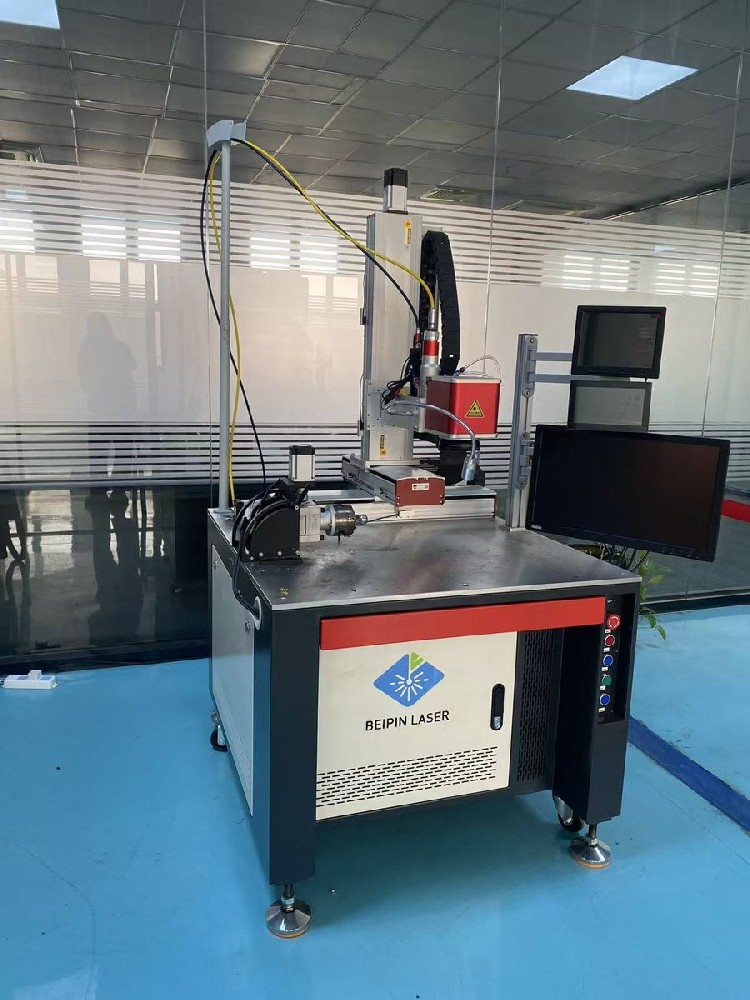
QCW Fiber vs. YAG Laser Spot Welding: Precision Selection Guide
Short answer: For precision spot welding of sensor housings, thin metal diaphragms, precision medical metal assemblies, and miniature electronic parts, a 150W (1500W peak) air-cooled QCW fiber laser generally replaces lamp-pumped Nd:YAG spot welders where tight heat-affected zones, repeatable pulse energy, and low maintenance matter. Legacy YAG systems rely on flashlamps that degrade over time and require water-chiller upkeep, whereas a 1070±10 nm QCW fiber laser delivers stable beam quality, programmable three-stage pulse shaping, and a compact chiller-free footprint.
Key engineering differences: 150W air-cooled QCW fiber vs. lamp-pumped YAG
| Evaluation factor | 150W Air-Cooled QCW Fiber (BP-W-P150) | Lamp-Pumped Nd:YAG Spot Welder |
|---|---|---|
| Laser architecture & wavelength | 1070 ± 10 nm ytterbium fiber; 150 W average / 1500 W peak | 1064 nm flashlamp-pumped crystal rod |
| Working spot size & beam quality | Adjustable 0.10–0.30 mm process spot with crisp energy boundaries (50 / 100 μm fine-core fiber) | Larger beam divergence; spot profile drifts as lamp ages and thermal lensing builds up |
| Pulse shaping & pulse width | 0.2–50 ms with programmable three-stage waveform (ramp-up, plateau, ramp-down) | Basic waveform control; flashlamp decay causes shot-to-shot energy drift between lamp changes |
| System energy stability | ≤ ±2% system energy stability (independent real-time optical negative-feedback closed-loop module optional) | Output declines steadily over flashlamp life; frequent recalibration required |
| Cooling & maintenance | Precision air-cooled; no water chiller, no flashlamp replacement, no condensation risk | Water chiller + deionized water upkeep + periodic flashlamp and protective optics replacement |
| Visual alignment & positioning | 2 MP coaxial CCD visual observation paired with a precision motion stage (±0.01 mm repeatability) | Often relies on microscope viewing; coaxial camera calibration and stage integration vary widely |
When a 150W QCW fiber laser makes the biggest difference
Thin stainless steel and titanium diaphragms (sensors & pressure transducers): Narrow pulse widths and ramp-down shaping reduce burn-through, pinhole formation, and weld-pool cracking around thin-walled membranes.
Medical precision metal components: Endoscopic structural assemblies, miniature stainless steel / titanium / Nitinol metal components, and precision sensor probes benefit from low heat input and clean coaxial CCD visual alignment before firing (process suitability verified by incoming-material sample validation).
High-reflectivity metals (copper, aluminum, gold-plated pins): Programmable ramp-up pulses gently break through initial surface reflectivity instead of hitting cold metal with a harsh square spike that triggers spatter.
Multi-shift production cells: Removing water chillers and flashlamps eliminates gradual output drift and unplanned downtime across shifts.
When legacy YAG may still be evaluated
Shops running low-volume manual touch-up or jewelry work on existing YAG benches where pulse-to-pulse statistical repeatability is not audited.
Processes requiring very high single-pulse energy (tens of joules in long pulses) on thick, heavy cross-sections rather than thin precision micro-joints.
How to verify before selecting equipment
Parameter tables alone cannot confirm weldability on dissimilar alloys, plated surfaces, or tight-tolerance assemblies. A structured incoming-material trial validates the actual conduction-welding window on your parts:
Prepare 15–20 representative part sets (matching production plating, surface finish, and cleanliness).
Define target spot diameter, cosmetic criteria, and mechanical strength targets in advance.
Run process-window trials across spot defocus, three-stage pulse shaping, and shielding gas (N2 or Ar).
Inspect samples via Beipin Laser's standard in-house optical microscopy visual inspection and push/pull mechanical testing; where metallographic cross-sectioning or X-ray void inspection is required, external third-party or customer laboratories are coordinated per project.
Evaluating QCW vs. YAG for your precision metal parts? Share drawings and material specs for process feasibility review. BP-W-P150 QCW Spot Welder · Sample Test Request · WhatsApp +86 186 1631 3040
Post a comment